SAMRASS
The Mine Health and Safety Inspectorate revisited the entire system of accident reporting and record-keeping in the South African Mines Reportable Accidents Statistical System [SAMRASS] system. In order to produce a good quality statistical product in line with the needs and requirements of the users this system was established in 1988 subject to the conditions embodied in the Mine Health and Safety Act 29 of 1996 as amended and the relevant regulations.
The correct description of accidents or dangerous occurrences is of utmost importance if the statistics produced from these reports are to be meaningful. It is therefore important that mines:
Contact us: mhsi@dmpr.gov.za
Download resources below
Fatality and injury rate trends
The fatality and injury frequency rate trends per million hours worked is a number calculated using a rounded-off figure conversion factor of 2 200 as the South African mining industry does not report on the actual hours worked.
The assumption is that each person works for an average of 48.9 weeks in a calendar year, discounting weekends, public holidays and annual leave days. The Basic conditions of Employment Act, 1997 (Act 75 of 1997) requires a person to work not more that 45 hours per week. Therefore, the conversion factor is rounded-off to 2 200 hours per person per year.
The rate is annualised, therefore, for a full year it is calculated as follows:

Contact us: mhsi@dmpr.gov.za
Occupational fatalities and injuries reported
Mining is known as one of the most dangerous occupations in the world with many contributing factors that causes accidents in the mining environment resulting in fatalities and occupational injuries.
South Africa has improved its safety level when compared to international peers but these markets have considerably less-complicated mining sectors than South Africa which has some of the deepest mines in the world.

The Mine Health and Safety Inspectorate continuously examine practices towards achieving a zero harm goal. Compliance with the Mine Health and Safety Act 29 of 1996 as amended and its regulations is crucial to provide safe and healthy working conditions for miners in the South African mining industry.
The health and safety of any and all mine workers in the South African mining industry remain at the centre of the work the Mine Health and Safety Inspectorate do. The Inspectorate is committed to the principle of zero harm and aims to achieve world-class safety performance through close collaboration with its tripartite partners.
Contact us: mhsi@dmpr.gov.za
|
2020-2029
|
2010-2019
|
|
YEAR
|
FATALITIES
|
INJURIES
|
YEAR
|
FATALITIES
|
INJURIES
|
|
2029
|
|
|
|
|
2019
|
ò
|
51
|
ñ
|
2 452
|
|
2028
|
|
|
|
|
2018
|
ò
|
81
|
ò
|
2 426
|
|
2027
|
|
|
|
|
2017
|
ñ
|
90
|
ò
|
2 668
|
|
2026
|
|
|
|
|
2016
|
ò
|
73
|
ò
|
2 846
|
|
2025
|
|
|
|
|
2015
|
ò
|
77
|
ñ
|
3 139
|
|
2024
|
ò
|
42*
|
ò
|
1 970*
|
2014
|
ò
|
84
|
ò
|
2 700
|
|
2023
|
ñ
|
56
|
ñ
|
2 184
|
2013
|
ò
|
93
|
ò
|
3 126
|
|
2022
|
ò
|
49
|
ò
|
2 065
|
2012
|
ò
|
112
|
ñ
|
3 367
|
|
2021
|
ñ
|
74
|
ñ
|
2 141
|
2011
|
ò
|
123
|
ò
|
3 299
|
|
2020
|
ñ
|
60
|
ò
|
1 813
|
2010
|
ò
|
127
|
ò
|
3 438
|
Disaster-type accidents in mining
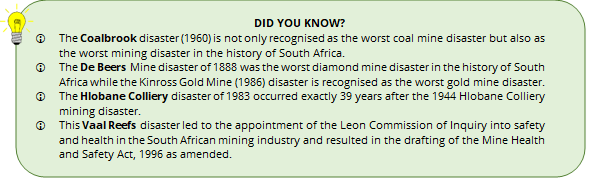
The South African mining industry has been plagued by challenges of fatalities and injuries resulting from mining activities for more than a century. During the 1980s more disasters occurred than in any other decade in the history of mining in South Africa.

Since as early as 1913, it was found that falls of ground are a common cause of mine accidents and injuries. Today, falls of ground accidents are still a major cause of fatalities with rock bursts increasing the fatality rate in the gold mines three times the average at depths below 3 000 metres. Other contributing casualty classifications for fatalities and injuries in mining are transportation and mining, and general type accidents.
The past ten years has seen significant improvements in safety for mine employees. This resulted in sustainable downward trends in injuries and fatalities. As the regulator of the sector, the implementation of the enforcement measures as contained in the Mine Health and Safety Act 29 of 1996 as amended remains a key priority.
|
FATALITIES
|
INJURIES
|
DATE
|
MINE
|
REGION
|
|
435
|
|
1960-01-21
|
COALBROOK COAL MINE
Clydesdale Colliery
|
Free State
|
|
202
|
|
1888-07-11
|
DE BEERS MINE
|
Northern Cape
|
|
177
|
235
|
1986-09-16
|
KINROSS GOLD MINE
Gencor Ltd
|
Mpumalanga
|
|
125
|
0
|
1926-10-08
|
Durban Navigation Collieries
|
KwaZulu-Natal
|
|
104
|
0
|
1995-05-10
|
VAAL REEFS GOLD MINE
Anglo American Corporation
|
North West: Klerksdorp
|
|
78
|
4
|
1923-05-16
|
Natal Navigation Collieries and Estate Company Ltd
|
KwaZulu-Natal
|
|
78
|
0
|
1935-07-31
|
NEW MARSFIELD COLLIERY
Marsfield Consolidated Collieries
|
|
|
70
|
5
|
1908-02-13
|
GLENCOE COLLIERY
Northfield
|
|
|
68
|
8
|
1938-09-12
|
HLOBANE COLLIERY
Iron and Steel Corporation (Iscor) Ltd
|
KwaZulu-Natal
|
|
65
|
|
1969
|
BUFFELSFONTEIN GOLD MINE
Durban Roodepoort Deep (DRD) Ltd
|
North West: Klerksdorp
|
|
64
|
|
1983-09-12
|
HLOBANE COLLIERY
Iron and Steel Corporation (Iscor) Ltd
|
KwaZulu-Natal
|
|
62
|
5
|
1987-08-31
|
ST HELENA GOLD MINE
Gencor Ltd
|
Free State
|
|
57
|
13
|
1944-09-12
|
HLOBANE COLLIERY
Iron and Steel Corporation (Iscor) Ltd
|
KwaZulu-Natal
|
|
53
|
0
|
1993-05-13
|
MIDDELBULT COLLIERY
Sasol Mining (Pty) Ltd
|
Mpumalanga
|
|
50
|
|
1967-07-25
|
NO 3 SHAFT
Western Deep Levels
|
Gauteng
|
|
41
|
|
1978-12
|
VAAL REEFS GOLD MINE
Anglo American Corporation
|
North West:
Klerlsdorp
|
|
38
|
0
|
1930-05-20
|
BURNSIDE COLLIERY
|
|
|
36
|
51
|
1937-03-19
|
SIMMER AND JACK MINES
|
|
|
35
|
17
|
1987-04-09
|
TAFELKOP SHAFT
Ermelo Mine Services
|
Mpumalanga
|
|
34
|
0
|
1924-12-17
|
SOUTH VERTICAL SHAFT
Randfontein Estates
|
Gauteng
|
|
34
|
0
|
1937-03-30
|
Durban Roodepoort Deep (DRD)
|
Gauteng
|
|
33
|
10
|
1985-08-12
|
MIDDELBULT COLLIERY
Sasol Mining (Pty) Ltd
|
Mpumalanga
|
|
31
|
8
|
1927-02-25
|
East Rand Proprietary Mines (ERPM)
|
Gauteng
|
|
31
|
|
1980-03-27
|
VAAL REEFS GOLD MINE
Anglo American Corporation
|
North West:
Klerksdorp
|
|
28
|
3
|
1930-03-10
|
CROWN MINES
|
Gauteng
|
|
27
|
17
|
1939-06-23
|
Randfontein Estates
|
Gauteng
|
|
27
|
|
1962-12-12
|
Wes Driefontein GM Co Ltd
|
Gauteng
|
|
23
|
|
1923
|
Randfontein Estates Gold Mining Company
|
Gauteng
|
|
21
|
17
|
1990-09-12
|
VAAL REEFS GOLD MINE
Anglo American Corporation SA
|
North West: Klerksdorp
|
|
21
|
3
|
1963
|
Grootvlei Proprietary Mines Ltd
|
Gauteng
|
|
20
|
8
|
1918-10-01
|
Farrer Incline Shaft
East Rand Proprietary Mines (ERPM)
|
Gauteng
|
|
20
|
3
|
1996-11-27
|
ROVIC DIAMOND MINE
Kleinkor Sewentien (Pty) Ltd
|
Free State
|
|
19
|
2
|
1999-07-29
|
MPONENG MINE
AngloGold Limited
|
Gauteng
|
|
18
|
13
|
1997-07-21
|
HARTEBEESTFONTEIN GOLD MINE
Durban Roodepoort Deep (DRD) Ltd
|
North West: Klerksdorp
|
|
17
|
20
|
1985
|
East Rand Proprietary Mines (ERPM) Ltd
|
Gauteng
|
|
16
|
1
|
1994-02-24
|
GLORIA COLLIERY
Koornfontein Coal Mine
|
Mpumalanga
|
|
16
|
2
|
1973-06-28
|
ORAGNIA SHAFT
Buffelsfontein Gold Mining Company Ltd
|
North West: Klerksdorp
|
|
14
|
4
|
1989-08-14
|
WEST DRIEFONTEIN GOLD MINE
Gold Fields Ltd
|
Gauteng
|
|
14
|
|
1980-10-03
|
BALMORAL MINE
|
Gauteng
|
|
13
|
|
|
BEATRIX MINE NO 2 SHAFT
Gold Fields Ltd
|
Free State
|
|
12
|
5
|
1990-10-18
|
WESTERN DEEP LEVELS WES WITS OPERATIONS
AngloGold Ashanti
|
Gauteng
|
|
12
|
7
|
1987-05
|
COALBROOK COAL MINE
Clydesdale Colliery
|
Free State
|
|
12
|
1
|
1989-01-30
|
SASOL DRIE PLANT
Sasol Mining (Pty) Ltd
|
Free State
|
|
11
|
|
1982-11-12
|
ERMELO MINE
Gencor Ltd
|
Mpumalanga
|
|
11
|
1
|
1994-01-10
|
KLOOF GOLD MINE LEEUDOORN DIVISION
Sibanye Gold Ltd
|
Gauteng
|
|
10
|
15
|
1986-08
|
DEELKRAAL GOLD MINE
Gold Fields Ltd
|
Gauteng
|
|
10
|
5
|
1988-05-14
|
MASIMONG
Harmony Gold Mining Company
|
Free State
|
|
10
|
|
1989-07-25
|
KLOOF GOLD MINE
Gold Fields Ltd
|
Gauteng
|
|
10
|
12
|
1990-08-31
|
PRESIDENT STEYN GOLD MINE
Harmony Gold Mining Company Ltd
|
Free State
|
|
10
|
1
|
1992-02-03
|
WESTERN DEEP LEVELS
West Wits Operations AngloGold Ashanti
|
Gauteng
|
|
10
|
7
|
1996-03-25
|
TSHIKONDENI COAL MINE
Iron and Steel Corporation Ltd (Iscor)
|
Limpopo
|
|
10
|
29
|
1997-05-07
|
DEELKRAAL GOLD MINE NO 1 SHAFT
Gold Fields Ltd
|
Gauteng
|
Contact us: mhsi@dmpr.gov.za
Mining tragedies
South Africa is known for its diverse wealth of minerals, but even better known for a very well-regulated mining industry. The Mine Health and Safety Inspectorate continuously enforce legislation and national mining standards to reduce mining deaths and occupational injuries.The overall number of deaths in the South African mining industry has declined over the past decades.
The greatest impact of mining accidents is noticed amongst the family members and colleagues left behind after a mine worker lost his or her life.
Jagersfontein Diamond Mine [2022]
On Sunday, 11 September 2022 the wall of the tailings storage facility of the Jagersfontein Diamond Mine in the small town of Jagersfontein in the Free State collapsed. On 28 September 2022, a further collapse at the tailings dam occurred. The mudslide left death and destruction in its wake.
The Department of Water and Sanitation [DWS] implemented administrative enforcement measures and issued a directive dated 12 September 2022 in terms of Section 20 of the National Water Act, 1998 (Act 36 of 1998). This directive pertains to the release of a substance that pollutes (or has the potential to pollute) or have a detrimental effect on a water resource.
Lily Mine [2016]
On 5 February 2016 a collapse in one of the shafts at the Vantage Goldfields’ Lily Mine in Barberton, Mpumalanga trapped three surface miners in a container underground and 87 underground mine workers were safely brought to surface shortly after the collapse. After the incident, numerous rescue attempts were undertaken to reach the trapped miners.
Rescue attempts had to be stopped as it proved to be dangerous after a secondary collapse at the mine occurred and the surrounding surface was deemed unstable. It was also difficult to determine at which level the container with the three trapped mine workers was situated.
In terms of Section 65(1) of the Mine Health and Safety Act 29 of 1996 as amended, the Department of Mineral Resources and Energy launched an investigation into the accident on 28 June 2016 and released the final report on 12 March 2018. This report did not establish the cause of the accident and an administrative fine of R1 million was issued in September 2020.
Marikana [2012]
Violence triggered by escalating labour unrest on the seventh day of an illegal strike at the Marikana Mine near Rustenburg in North West resulted in the death of 44 people between 12 and 16 August 2012. Today this incident is known and referred to as the Marikana Tradegy. The strike ended on 18 September 2012, after six weeks, when a collective wage agreement was signed, and the strikers returned to work on 20 September 2012.
An official commission of inquiry, chaired by retired Judge Ian Farlam, was appointed by the President of South Africa. The Marikana Commission of Inquiry concluded its investigation in 2015.
Merriespruit [1994] On 22 February 1994, the Merriespruit No. 4 tailings dam failed after a thunderstorm earlier that afternoon resulted in approximately 50 millimetres of rain within 30 minutes in the area, and flooded parts of Virginia in the Free State. When the dam failed, 600 000 m³ of water and tailings flowed over a distance of approximately four kilometres engulfing 80 homes and resulting in the death of 17 people. The Merriespruit Tailings Dam Disaster also caused widespread environmental damage in the area
Administrative fine system
The Download resources was issued by the Chief Inspector of Mines in 2011 in accordance with Section 49(6) of the Mine Health and Safety Act 29 of 1996 as amended.
The Mine Health and Safety Inspectorate has the power to order compliance through this system of administrative fines on an employer who failed to comply with the provision of the Mine Health and Safety Act 29 of 1996 as amended. An employer must pay any fine imposed within 30 days.
Money received in payment of the fines imposed, must be paid to the administrative fund established and controlled by the Mine Health and Safety Council [MHSC]. These funds are used to promote health and safety in the mining industry.
Contact us: mhsi@dmpr.gov.za
Download Resources:
Guideline on Administrtive Fines System [2011]
Levies
The levies are based on the health and safety risks of the operating mines in South Africa. The Mine Health and Safety Council [MHSC] administers the collection of these levies and the funds generated from these levies are used in research projects.
The revised levy model has a balanced approach and aims to be pro-active with reference to occupational health and safety interventions to mitigate accidents and dangerous occurrences at mines in South Africa.

For more information, contact the Mine Health and Safety Council [MHSC] during office hours at:
The South African mining sector has historically played a pivotal role in shaping the national economy and job market. Employment reached its peak in 1987 with over 760,000 workers, but by 2015 the workforce had declined to approximately 490,000.
Today, the Platinum Group Metals (PGM) sector employs the largest share of the workforce, followed by Gold and Coal Mining. For detailed quarterly labour statistics by region, see the Download Resources section below.
For more information, contact mhsi@dmpr.gov.za